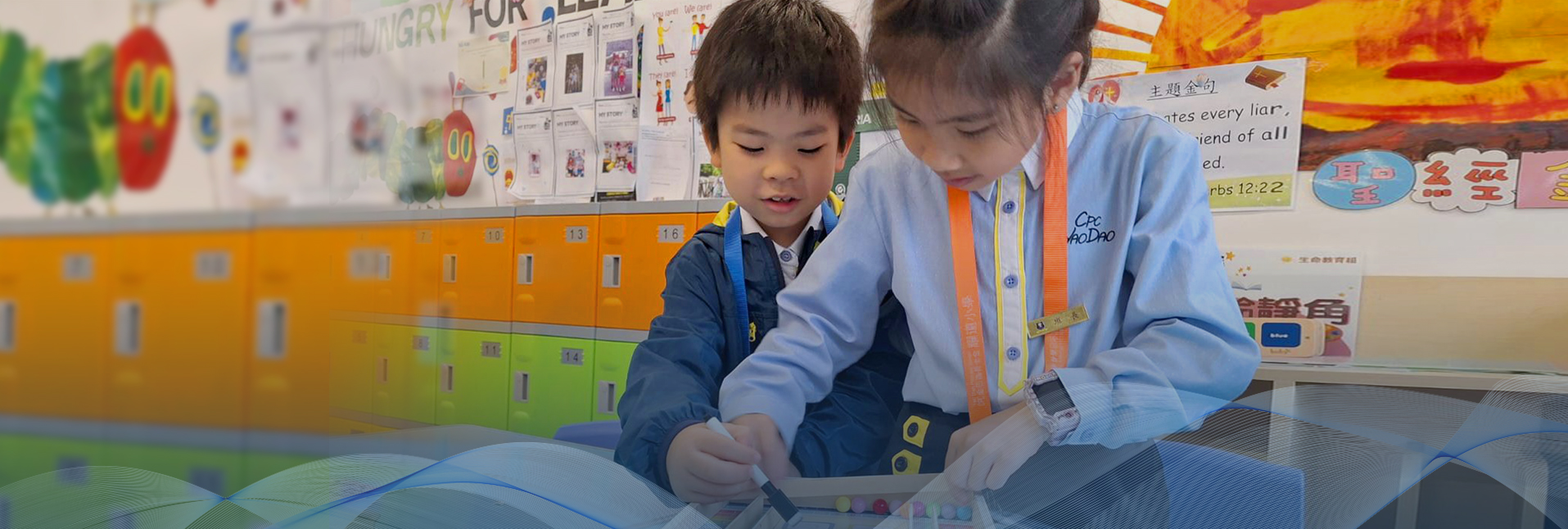
Primary 1 students often face adaptation difficulties with school "hardware" that is completely different from kindergarten, such as the school environment, classroom layout, and school hours, as well as "software" like learning content, formats of group activities, homework, and assessment requirements.
An effective "Kindergarten-Primary Transition" curriculum is crucial for children to build positive learning attitudes and habits. It also lays a solid foundation for their learning in the primary school stage and promotes their healthy physical and mental development.
| Academic Period | Strategies |
| Late August (Every Year) |
Primary 1 Orientation Week • Students return to school before the new term starts to familiarize themselves with the school environment and teachers. • Individual parent-teacher interviews are arranged to promote home-school communication and cooperation. |
|
Late August or Early September (Every Year) |
Blessing Ceremony for Primary 1 Students • Co-organized with Yao Dao Church. • Exclusively designed for P1 students and their parents. |
| October (Every Year) |
Primary 1 School Life Assessment Checklist • Teachers reflect on students' learning habits and conditions during their first month at school through an assessment checklist given to parents. Evaluated areas include: taking the initiative to ask questions, getting along with classmates, writing speed, observing discipline, and responding actively. |
| November (Every Year) |
Form-based Parents' Meeting • The school specially organizes form-based parents' meetings. Parents visit the school to meet with Chinese, English, and Mathematics teachers and receive the students' "Unit Learning Rubrics." During the meeting, teachers and parents review the students' learning progress together and discuss ways to improve their learning. |
| Throughout the School Year |
Chinese and English Dictation & Writing Activities
• Teachers conduct dictation and writing activities in class to gradually build students' literacy and writing skills. • Different from traditional dictation systems, teachers arrange the content and frequency according to the students' abilities, effectively cultivating their interest and capability in recognizing and writing words. Formative Assessment Mode
• All subjects adopt a formative assessment mode for evaluation. • Chinese, English, Mathematics, and General Studies are taught in units. Parents can understand the learning objectives of each unit through the Unit Learning Framework. • Parents will receive "Unit Learning Rubrics" for Chinese, English, Mathematics, and General Studies to track their children's learning progress, thereby helping them improve and raise their learning standards. |
| Throughout the School Year |
Native-speaking English Teacher (NET) Lessons • Lessons with Native-speaking English Teachers every day. • Students engage in fun English activities with Native-speaking English Teachers during recess. PE Lessons Conducted in English • Lower primary students have one Physical Education lesson conducted by a Native-speaking English Teacher per teaching cycle. • Students speak English while exercising, creating an optimal English learning environment. |